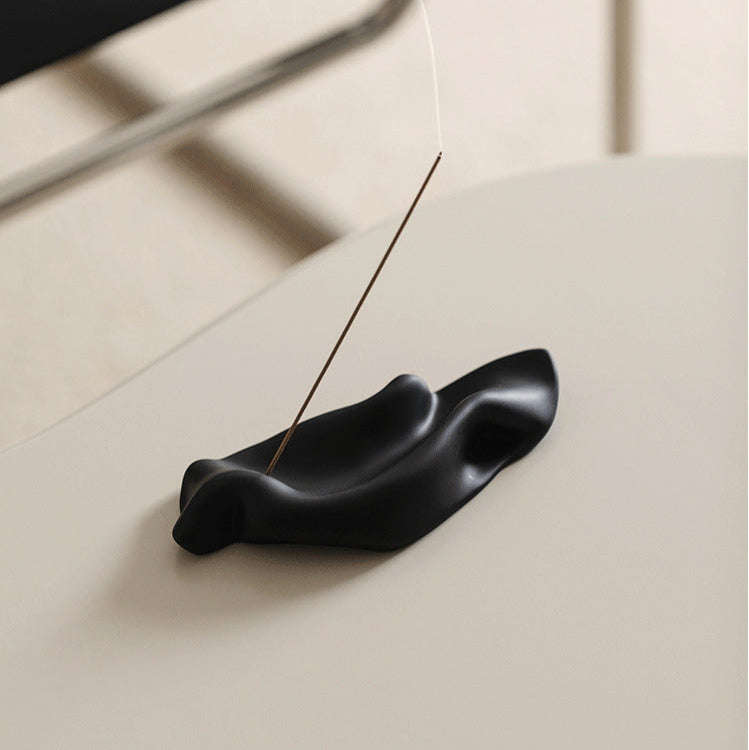

What "Low Smoke" Actually Means
Walk into any room where someone has been burning a bamboo-core incense stick, and you will notice it before you smell anything. A visible column of grey-white smoke rises and spreads, settling into curtains and lingering long after the stick has burned out. This is not a flaw in the incense — it is a physical consequence of how the stick was built.
"Low smoke" is not a marketing claim about air purity. It is a direct description of what you see: less visible particulate rising from the burning tip. The distinction turns on whether the incense stick contains a bamboo core or is made entirely of compressed aromatic material.
For someone burning incense in an apartment, a studio, or a shared living space, this difference is practical rather than philosophical. A coreless stick produces a thinner, faster-dispersing smoke column. A bamboo-core stick in the same conditions produces a thicker, more persistent smoke trail.
Core vs. Coreless: How Construction Shapes Smoke Output
Bamboo-Core Construction
A bamboo-core incense stick begins with a thin bamboo splint — typically 4 to 12 inches long. The splint is dipped or coated in a paste made from aromatic wood powders, binders, and sometimes essential oils. When the finished stick burns, two separate materials combust simultaneously: the aromatic paste on the outside, and the bamboo splint at the center. Bamboo consists primarily of cellulose, hemicellulose, and lignin — all combustible plant polymers. This dual-material combustion produces a visible smoke column that is noticeably thicker and whiter than what a coreless stick generates.
Coreless Construction
A coreless incense stick has no internal support. The entire stick is a single, homogeneous extrusion: finely ground aromatic woods, spices, resins, and herbs are blended with a natural binder — typically makko powder (ground Machilus thunbergii bark) — moistened into a dough, and extruded into thin rods. Because every millimeter of the stick is made of the same material, combustion proceeds uniformly. The stick burns more slowly and with less visible smoke than a bamboo-core equivalent.
The ash tells the same story. A bamboo-core stick leaves behind the charred core skeleton. A coreless stick burns to a fine, uniform grey-white ash — no skeleton, no residual structure.
Why Bamboo-Core Incense Produces More Visible Smoke
The bamboo core is not an inert scaffold. It is active fuel. Roughly 30 to 50 percent of the total combusted material in a bamboo-core stick is the core itself — not the fragrance materials you purchased the stick for. Light a bamboo-core stick and a coreless stick side by side in still air. Within thirty seconds, the bamboo-core stick produces a smoke column that is visibly thicker, whiter, and more persistent.
The Role of Binders: Makko, Tabu Bark, and Synthetic Alternatives
Makko Powder (Natural Binder)
Makko powder is the traditional combustible binder used in Japanese incense-making. It is produced by grinding the dried inner bark of the Machilus thunbergii tree. Makko serves a dual purpose: it acts as an adhesive when mixed with water, binding the aromatic powders into a workable dough; and it acts as a combustible — burning smoothly and evenly. Because makko is itself a natural plant material (cellulose-based bark), it burns with relatively low visible smoke compared to synthetic binders.
Synthetic Binders
Many mass-produced incense sticks use synthetic binders. The most common is diethyl phthalate (DEP), a colorless liquid plasticizer. From a purely mechanical standpoint, synthetic binders tend to produce more visible smoke than makko. The combustion of phthalate-based compounds generates denser particulate output than the combustion of a cellulose-based bark powder.
Japanese Incense vs. Indian Incense: Two Construction Traditions
The smoke difference between Japanese and Indian incense follows directly from their physical construction. Indian incense uses the bamboo-core stick (agarbatti) — louder in scent and thicker in smoke. Japanese incense is almost always coreless — subtler, drier, and more wood-forward, with less visible smoke.
If you burn incense in a large, well-ventilated house, bamboo-core incense may present no practical issue. If you burn incense in a 600-square-foot apartment with neighbors on the other side of a shared wall, visible smoke becomes a material consideration. The coreless Japanese method solves this problem at the level of construction.
Ventilation in Practice: Room Size, Window Placement, and Air Flow
Window Placement and Cross-Breeze: The most effective arrangement is a cross-breeze — two open windows on opposite walls, with the incense positioned in the path of the airflow. If only one window is available, position the incense holder on the windowsill itself.
Room Size: In rooms under 100 square feet, a coreless stick with a window cracked often produces no visible accumulation at all.
Placement: Do not place the incense holder directly beneath a smoke detector. Keep the holder at least six feet from the nearest detector. Do not place the holder directly on a wooden surface without a non-combustible tray or plate underneath.
The Low-Smoke Landscape: Asayu Japan, Nippon Kodo, and Where MUSO Fits
Asayu Japan has built its brand around the "low smoke" claim, offering a dedicated low-smoke incense line. Nippon Kodo maintains an entire "Smokeless & Less Smoke" product category. MUSO Collection does not market a "low-smoke" product line — what it offers through its Dongzhi incense range is coreless Japanese incense that produces less visible smoke as a matter of physical construction, not marketing.
Dongzhi Coreless Incense: Low-Smoke by Construction
Dongzhi Agalloch Eaglewood Incense Sticks — Eaglewood (agarwood) is one of the most revered materials in incense-making. Dongzhi's agalloch eaglewood stick is coreless, makko-bound, and burns with a thin, fast-dispersing smoke column.
Dongzhi Coffee Latte Incense Sticks — A distinctive scent built around roasted coffee and warm woody notes, with agarwood and sandalwood forming the base and honey tones rounding out the profile. The coreless construction keeps the scent profile consistent from first inch to last.
Dongzhi Ambergris Incense Sticks — An unusual scent profile in the incense category: marine and mineral. The coreless construction keeps the visible smoke thin enough that the scent registers before the smoke does.
Fuji Night Rain Incense — Draws on petrichor — the earthy, mineral smell of rain on dry ground — combined with a subtle wood base. Like Dongzhi's sticks, Fuji incense is coreless and bound with natural plant-based materials.
Dongzhi Tranquil Harmony Incense Set — The full Dongzhi sampling experience: eight scents in a single box. At $19, it is the lowest-barrier way to experience the entire coreless Dongzhi range.
FAQ: Common Questions About Low-Smoke and Coreless Incense
What does "low smoke incense" actually mean?
It means the incense produces less visible smoke when burned. This is a physical property of the stick's construction — specifically, whether it contains a bamboo core or is coreless. "Low smoke" describes what the eye observes; it is not a claim about air composition or health effects.
Do coreless incense sticks really produce less visible smoke than bamboo-core sticks?
Yes. Remove the bamboo, and the visible output decreases. This is observable without any specialized equipment — light one of each in still air and compare the smoke columns.
How can I further reduce visible smoke when burning incense in a small apartment?
Three practical steps: burn coreless Japanese incense rather than bamboo-core sticks; place the holder near a cross-breeze between two open windows or on a windowsill; keep the holder at least six feet from any smoke detector and away from dead-air corners.
Is "low smoke" the same as "smokeless"?
No. "Smokeless" is a stronger claim used by some manufacturers for specially formulated incense. "Low smoke" describes standard coreless Japanese incense: it produces less visible smoke than bamboo-core alternatives, but it is not smoke-free.
Incense Built for Shared Spaces
The practical difference between a coreless Japanese incense stick and a bamboo-core stick is not subtle — it is visible, measurable by the eye, and repeatable across every burn. MUSO Collection's Dongzhi line — coreless, SGS-certified, makko-bound — offers that construction at an accessible price point.
Browse the full incense collection · Shop natural incense · Explore incense holders
Further Reading:
- Types of Incense: A Complete Guide
- How to Use Incense Sticks: A Beginner's Guide
- Is Incense Safe? The Complete Guide to Natural, Non-Toxic Incense
- Where to Place Incense in Your Home: A Room-by-Room Guide
This article is for informational purposes about incense products and craftsmanship. MUSO Collection makes no claims about the health effects of its products.