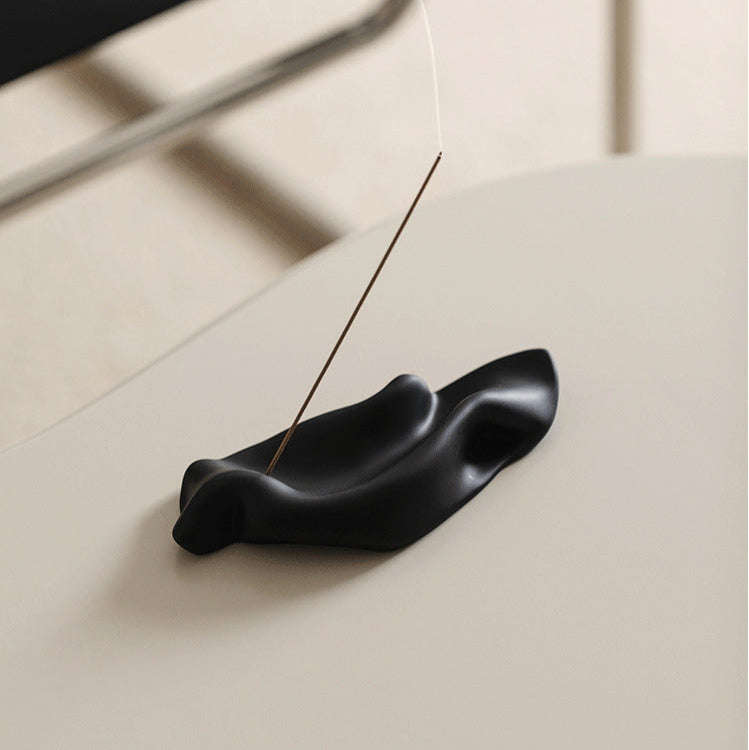

This article is part of the MUSO Living editorial series. MUSO Collection sources artisan incense from independent makers across China and Japan, and the manufacturing details below are drawn from our direct relationships with those workshops, alongside published technical references from Asayu Japan's production documentation, Nippon Kodo's raw materials series, and peer-reviewed process literature.
How Is Incense Made? The Question Behind Every Stick
A finished incense stick is a surprisingly engineered object. It must burn steadily without flaming, hold its shape through weeks of drying without cracking, release its aromatic materials in the right sequence as the ember travels down its length, and leave behind a clean, fine ash. None of that happens by accident. Every step in the manufacturing process serves one of those physical requirements.
This article follows the artisan incense manufacturing process from start to finish: raw materials, binders, forming methods, the core-versus-coreless construction debate, drying and aging, and the physical quality markers that separate handcrafted incense from mass-produced alternatives.
The Materials That Become Incense
Aromatic Wood Powders
The primary aromatic material in most quality incense is heartwood. Sandalwood (Santalum album, particularly old-growth Mysore stock) and agarwood (also called eaglewood, agalloch, or chenxiang, sourced from Aquilaria species) are the most prized. Cedar, cypress, and pine are also used, particularly in temple-grade incense.
These heartwood sections are chipped, then ground in stages until they reach a particle size fine enough to pass through a mesh screen, typically 80–120 mesh. The grind matters: too coarse, and the stick won't bind properly and will burn unevenly; too fine, and the particles pack too densely, restricting airflow and causing it to extinguish mid-burn.
Sandalwood powder is relatively oily due to its high essential oil content, which means sandalwood-heavy blends often require slightly more binder to achieve the same structural integrity. Agarwood is drier and more fibrous — agarwood sticks tend to be slightly more brittle before aging.
Tree Resins
Resins — frankincense, myrrh, benzoin, copal — are the hardened sap of specific trees, collected by tapping the trunk and allowing the exudate to dry. They contribute aromatic complexity and act as a secondary binder.
Essential Oils
Essential oils are added in small quantities during blending for aromatic character. Because oils are volatile and evaporate during drying, formulations that rely heavily on essential oils will lose some aromatic intensity during the aging process. High-quality incense is primarily wood-and-resin based, with oils serving as an accent.
Herbs and Spices
Dried botanicals — star anise, dried citrus peel, mugwort, clove bud, cassia bark — are sometimes included in traditional formulations. They contribute aromatic top notes but burn faster than wood powders.
For a deeper breakdown of how these materials translate into different incense forms, see our complete guide to types of incense. And for the specific properties of agarwood, our agarwood and eaglewood guide covers sourcing, grading, and classification levels.
Natural vs. Synthetic Binders: Makko Powder and Tabu-no-ki Bark
Every incense stick requires a binder. The choice of binder determines the stick's burn characteristics, smoke output, and the degree to which the aromatic materials' scent comes through cleanly.
Makko Powder: The Traditional Japanese Binder
In Japanese-style incense, the standard binder is makko powder — the ground bark of the tabu-no-ki tree (Machilus thunbergii). Makko accounts for approximately 10–15% of the dry weight in a finished incense formulation. Makko's role is simultaneously structural and combustible: it forms a matrix that holds the wood and resin powders together, and its cellulose fibers smolder at a stable, predictable rate, producing a self-sustaining ember without added accelerants.
Critically, makko powder is nearly odorless when it burns — a neutral canvas that lets the aromatic woods and resins speak without interference. Charcoal, used as the structural base in many mass-produced sticks, burns hot and produces its own acrid note that competes with the intended fragrance.
Makko is sold in grades — typically four, from lower (more aromatic, more variable burn rate) to higher (less aromatic, more consistent combustion). Artisan incense makers generally select a mid-to-high grade.
Synthetic Binders and What They Indicate
If an incense stick burns with thick, dark smoke, leaves behind heavy, clumped ash, or emits a chemical scent when unlit — the binder is likely not makko. Common synthetic alternatives include charcoal powder (inert base; burns hot and fast), sodium nitrate (an accelerant), and synthetic gums and cellulose derivatives. None of these necessarily make a stick unsafe in any certified sense, but they change the physical burn characteristics — more smoke, faster burn, different ash texture.
Core vs. Coreless Construction: Two Paths to a Finished Stick
Bamboo-Core Sticks (Indian and Chinese Method)
The cored stick begins with a thin bamboo splint which is then coated with incense paste. India has an estimated 5,000 incense manufacturing companies, and roughly 200,000 women work part-time rolling bamboo-core sticks by hand. An experienced worker can produce approximately 4,000 raw sticks per day.
Coreless Sticks (Japanese Method)
Japanese-style incense contains no bamboo core. The entire stick is a solid extrusion of aromatic materials, wood powders, and makko binder. The physical properties differ in three measurable ways: coreless sticks burn hotter (the entire cross-section is combustible), produce less visible smoke (no bamboo lignin smoke), and deliver proportionally more fragrance (100% aromatic material vs. ~40% in a typical cored stick).
Which Is Better?
Neither construction is inherently superior. A cored stick from a quality producer will outperform a poorly made coreless stick every time. But the distinction matters: if you notice that a stick produces noticeably less smoke than another, or burns hotter, or has a purer scent, you're observing the physical consequences of coreless construction.
The Manufacturing Process, Step by Step
Step 1: Material Selection and Grinding
Raw materials arrive at the workshop in varied forms. Wood logs are sectioned, inspected, chipped, and milled in stages. Resins are frozen, then pulverized. Herbs and spices are dried to a specific moisture content before grinding.
Step 2: Formulation and Dry Blending
The ground materials are weighed according to a formulation. A typical Japanese-style stick formulation might be: sandalwood powder 45–55%, agarwood powder 10–15%, makko binder 12–15%, resins 10–15%, herbs and spices 5–10%, essential oils 1–3%. These ratios are not arbitrary — the binder percentage determines whether the stick holds together, the resin percentage affects ember temperature, and the ratio of fine to coarse particles affects burn rate.
Step 3: Wet Mixing and Kneading
Water is added to the dry blend — just enough to bring the mixture to a dough consistency. The dough is kneaded until it reaches uniform plasticity. Essential oils, if used, are added during this stage.
Step 4: Forming
Hand-extrusion (small-batch artisan): The dough is placed in a manual extruder with a die plate. The maker presses the plunger, forcing dough through the die in continuous strands, cut to length. Machine extrusion (commercial): A mechanical extruder feeds dough continuously through a multi-hole die. Hand-rolling for cored sticks: Wet paste is rolled into a thin sheet, the bamboo splint is laid along its center, and the two are rolled together by hand.
Step 5: Drying
Freshly formed incense sticks contain significant water. Drying protocols are specific to climate, season, and formulation: temperature typically 20–30°C, humidity controlled between 50–65% RH, gentle indirect airflow, duration 3–7 days for thin sticks and up to 14 days for thicker or resin-heavy formulations.
Step 6: Aging (Curing)
After drying, the sticks enter an aging period — stored in a climate-controlled environment for anywhere from two weeks to several months. Aging allows residual moisture to equilibrate and aromatic components to settle and integrate. Sticks packaged immediately after drying often smell sharp or green; aged sticks burn with a rounder, more cohesive scent.
Handcrafting vs. Machine Production: Quality Markers to Look For
Surface Texture and Uniformity
A well-made stick has a consistent diameter along its entire length, a smooth surface without cracks or pits, and a uniform color. Hand-rolled cored sticks will show slight surface irregularity — fine ridges from the rolling process. Machine-extruded coreless sticks should be nearly perfectly smooth.
Ash Color and Texture
When a stick finishes burning, the ash it leaves behind is a direct physical record of its composition. Light gray or white ash, fine and powdery, indicates clean combustion of plant materials. Dark, clumped, or gritty ash indicates incomplete combustion or non-combustible fillers.
Burn Consistency
A quality incense stick burns at a consistent rate from tip to base. Inconsistent burn — where one section burns fast and the next slows down — signals uneven material distribution in the dough.
Scent Profile When Unlit
Before lighting, a quality incense stick should smell like its ingredients — woody, resinous, herbal — not like perfume, chemicals, or nothing at all. In our sandalwood incense guide, we detail how to identify real sandalwood by scent.
SGS Certification and What It Means for Incense Manufacturing
SGS (Société Générale de Surveillance) is a Swiss testing and certification company. In the context of incense manufacturing, an SGS certification is a mechanical process verification — SGS tests a product against defined standards for restricted substances, heavy metals, and chemical residues. This is a mechanical safety and quality assurance standard, not a health claim. Several of the incense products in MUSO Collection's catalog — including the Dongzhi line — carry SGS certification.
How to Identify Quality Artisan Incense at a Glance
Before lighting: consistent diameter, smooth surface, uniform color, woody/resinous unlit scent, rigid but not brittle.
While burning: thin and light smoke column, steady ember advance, scent that evolves as the ember moves.
After burning: fine, light gray or white powdery ash, clean ash fall, subtle woody lingering scent.
If you're new to incense, a sampling set is the most direct path. The Dongzhi Tranquil Harmony Incense Set at $19 includes eight different scents — each SGS-certified and manufactured using the makko-bound, coreless construction method.
For those who gravitate toward wood-forward incense, the Fuji Artisan Soothing Incense is a 100% natural, handcrafted coreless stick with sandalwood and agarwood. And the Fuji Mysore Sandalwood Handcrafted Incense uses Mysore-region sandalwood — the gold standard for that species.
Explore our full incense collection and natural incense collection.
Frequently Asked Questions
How long does it take to manufacture a single incense stick?
From raw material grinding to a finished, aged stick ready for packaging, the total production timeline is typically 2–4 weeks for thin sticks and 4–12 weeks for thicker or resin-heavy formulations. The dominant time cost in artisan manufacturing is the aging period, not the hands-on labor.
What is the physical difference between a bamboo-core stick and a coreless stick?
Coreless sticks burn hotter (the entire cross-section is combustible), produce less visible smoke (no bamboo lignin smoke), and deliver proportionally more fragrance per millimeter of diameter (100% aromatic material versus approximately 40% in a typical cored stick). Neither construction is inherently better.
How can I tell if my incense uses natural binders like makko or synthetic binders?
The most reliable indicator is the ash. Makko-bound incense leaves fine, light gray or white ash that is soft and powdery. Synthetic binders produce darker, heavier ash that may clump or feel gritty. Third-party certifications like SGS can confirm binder composition through laboratory testing.
Does machine-made incense differ from handcrafted incense in quality?
Not inherently. The critical variables are material quality, formulation proportions, binder choice, and process control. A machine-extruded stick made with high-quality materials, dried slowly, and aged properly will outperform a hand-rolled stick made with inferior materials rushed to market.
For a practical guide to using incense sticks, see our beginner's guide to incense sticks.
This article is for informational purposes about incense products and craftsmanship. MUSO Collection makes no claims about the health effects of its products.